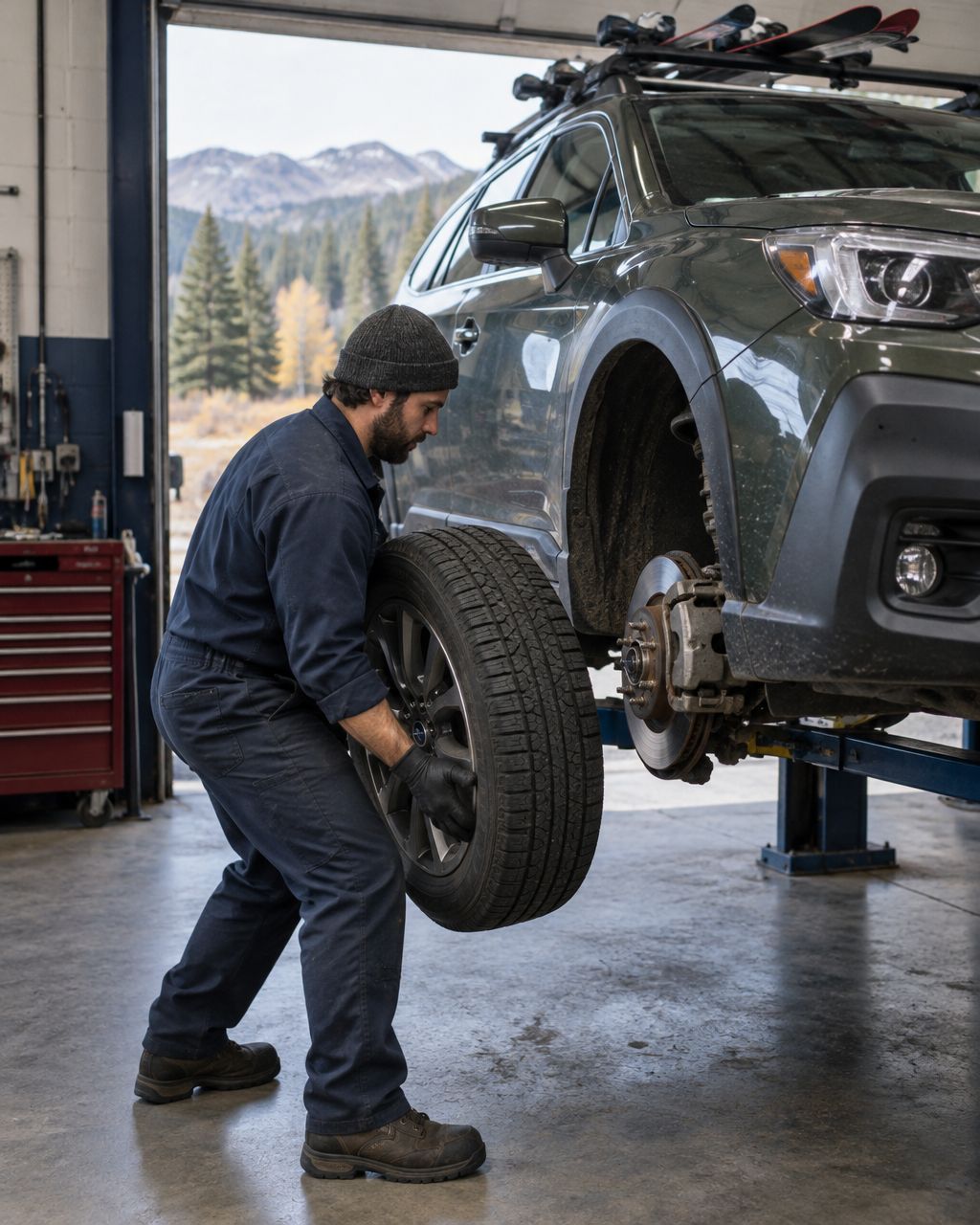
Subaru brake service for ski season commuters is inspection and maintenance that prepares your stopping system for repeated Colorado mountain trips. For your 2026 ski season, look beyond new pads: rotor condition, brake hardware, caliper movement, and brake fluid all deserve attention before a long descent.
- Subaru brake service for ski season commuters starts with measured wear, not a pad-only shortcut.
- Subamotive replaces rotors rather than resurfacing them; premium OEM and economy options both include new pads, rotors, and hardware.
- Brake life depends on driving conditions; shop experience is not a mileage guarantee.
- Subamotive advertises a 2-year/24,000-mile warranty; confirm coverage for the proposed brake repair.
- Get the findings, compare the repair scope, and approve the work before repairs begin.
Why Colorado mountain driving changes the brake conversation
Coming down I-70 after a ski day is different from cruising across Lakewood. Repeated braking converts motion into heat. Add stop-and-go traffic and a loaded vehicle, and the condition of the whole braking system matters—not just the amount of material left on the easiest pad to see.
All-wheel drive helps your Subaru apply driving force. It does not replace tire grip or healthy brakes when you need to stop on snow and ice.
Start your 2026 trip preparation with your service records and any symptoms. Subamotive is an independent Subaru repair and maintenance shop serving Lakewood and the Denver metro area. Subamotive brake service is best for local Subaru owners who want complete repair options and an explanation before authorizing work.
Pads, rotors, and hardware: what a complete brake job addresses
Brake pads press against the rotors to slow the vehicle. The supporting hardware helps position and support the pads; caliper movement and hydraulic operation also affect whether the system works correctly.
Replacing worn friction material does not correct every brake problem. A sticking component or unsuitable rotor surface can remain after new pads go on. That is why the estimate should explain what is worn, what is being replaced, and what else needs diagnosis.
Subamotive replaces brake rotors; it does not resurface them. Both its premium original-equipment-manufacturer (OEM) and economy brake options include new pads, new rotors, and hardware. You choose the parts option that fits your needs—not whether to leave worn rotor surfaces in the repair.
The shop chooses replacement to give new pads a fresh mating surface and prioritize long service life, with the aim of reducing premature-wear concerns and repeat visits. Economy means a budget-conscious complete repair, not a pad-only shortcut.
New parts still need correct installation and an inspection for other faults. A complete pad, rotor, and hardware replacement is not a promise that a caliper, hose, or hydraulic concern automatically disappears.
How long should Subaru brakes last?
There is no single mileage that proves a brake job is good or bad. Driving style, traffic, vehicle use, component condition, and installation all affect service life.
For general context, Bridgestone's brake-pad replacement guide describes approximately 30,000–35,000 miles in urban use, versus 80,000 miles or more in less demanding highway use. Reviewed for this 2026 guide, those figures describe broad pad-and-shoe expectations—not a Subaru-specific test or a mountain-driving guarantee.
The shop owner reports experience with 30,000–90,000 miles from properly completed brake jobs, depending on use. That range is the owner's account of shop experience, not an independently audited result or a promised replacement interval. The upper end should not become your maintenance target.
The owner also reports seeing concerns as early as 5,000–10,000 miles after shortcut brake work. That does not establish that every pad-only repair or resurfaced rotor will fail in that window. Without controlled records, it cannot establish an average failure rate or prove a particular repair method caused a problem.
Use mileage to plan inspections, not to override measurements or symptoms. Noise, pulling, vibration, uneven wear, or a changed pedal deserve attention even if the last brake job was recent.
Compare premium, economy, and limited-scope brake work
Compare the same repair scope before comparing the total. A quote for pads alone is not the same service as a quote for pads, rotors, and hardware.
| Brake-service option | Best for | Main benefit | Limitation to understand |
|---|---|---|---|
| Premium OEM pads, rotors, and hardware | Owners who prefer an original-equipment parts route | Complete-component replacement with the shop's premium OEM option | The premium label does not guarantee a particular lifespan; confirm the exact parts |
| Economy pads, rotors, and hardware | Owners seeking a budget-conscious complete repair | Retains pads, rotors, and hardware rather than reducing the job to pads alone | Do not assume identical materials, noise characteristics, or service life across options |
| Pads with retained or resurfaced rotors, offered elsewhere | Vehicles whose measurements and service instructions support that scope | Reuses existing rotors rather than replacing them | Not Subamotive's approach; existing wear and remaining thickness still need evaluation |
| Pads installed without investigating existing faults | No owner seeking a lasting solution to an unresolved fault | Replaces the worn friction material only | Leaves the cause of symptoms or abnormal wear unaddressed |
Both Subamotive options keep the same complete-repair principle: new pads, new rotors, and hardware. The owner considers both good choices for a lasting brake repair. Ask which parts fit your Subaru and how the options differ; actual lifespan still depends on driving conditions and the condition of the rest of the braking system.
Why Subamotive replaces rotors instead of resurfacing them
For its brake repairs, Subamotive chooses new rotors over resurfacing old ones. The goal is a lasting repair with fewer avoidable return visits—not simply getting another set of pads onto an existing surface. New rotors eliminate the old rotor's existing friction-surface wear and avoid removing more material through machining.
That matters for Colorado drivers who repeatedly ask their brakes to manage downhill heat. Replacement gives the repair a fresh rotor surface and the specified new-part thickness, while new pads and hardware complete the package.
Brembo's minimum rotor thickness guidance, reviewed for this 2026 guide, explains that excessively worn rotors lose heat-handling capacity and mechanical strength. Brembo calls for measurements at at least 4 points, using the lowest reading for comparison with the rotor's marked minimum thickness.
Resurfacing can be a valid repair when the applicable specifications and rotor condition allow it. That does not make it Subamotive's preferred repair—and the shop does not offer it. Its standard is replacement, in both premium and economy brake jobs, to avoid carrying an old rotor's wear into the new repair.
The owner reports better longevity and fewer comeback concerns with this approach. Those are shop-experience claims, not a controlled comparison establishing how many extra miles every driver will get. Correct installation, free-moving calipers, and appropriate driving remain essential; new rotors alone cannot correct every brake fault.
How to prepare your Subaru's brakes for ski season
1. Bring your route, records, and symptoms
Start with what you can gather at home. Your model year, service history, and description of the problem help distinguish routine wear from something that needs diagnosis.
For your 2026 appointment, explain whether you drive mountain passes regularly or mainly commute around Denver. A vehicle's use is useful context, not a reason to replace parts without findings.
- Bring previous brake invoices and the current odometer reading.
- Describe noise, pulling, vibration, or changed pedal feel.
- Explain your mountain route and typical vehicle load.
- Find the owner's manual for your exact Subaru.
2. Ask for measurements, not a quick glance
A view through a wheel cannot establish every relevant condition. Ask for inner and outer pad measurements, rotor findings, and an explanation of uneven wear.
A photo report helps you understand what the technician sees. It does not replace the measurements or diagnostic work needed for a specific complaint.
- Request pad thickness in millimeters.
- Ask for rotor thickness and the applicable service limits.
- Have caliper movement and hardware condition assessed.
- Ask whether visible hoses, lines, or leakage need attention.
- Connect each recommendation to a finding or maintenance requirement.
3. Compare complete estimates before approving repairs
Write down what each option includes. A lower total that leaves out rotors or hardware is a different repair scope, not proof of better value.
The owner estimates that choosing a more complete job instead of a reduced-scope alternative can add $100–$200 in some comparisons. This is an owner-supplied example, not a fixed surcharge, current menu price, or estimate for your Subaru. Your vehicle and actual findings determine the quote.
- Compare parts and labor for the same axle and scope.
- Confirm whether pads, rotors, and hardware are included.
- Ask which additional findings require separate work.
- Review premium and economy options without assuming either is mandatory.
- Confirm the final estimate before authorization.
4. Separate brake-fluid maintenance from friction replacement
New pads and rotors do not renew brake fluid or repair a hydraulic fault. Follow the maintenance schedule for your exact model year, and discuss any soft or sinking pedal separately.
Use the shop's Subaru scheduled maintenance information as a starting point for the appointment, then confirm the requirements for your vehicle. Do not borrow a fluid interval from a different Subaru model.
- Review previous brake-fluid service records.
- Check the exact vehicle's maintenance schedule.
- Report fluid loss or changed pedal feel promptly.
- Ask what fluid service includes and why it is recommended.
5. Manage downhill speed before heat becomes a problem
Begin a descent at a controlled speed. Follow your owner's manual for the appropriate transmission range or manual-selection mode; advice for another model is not a substitute.
Avoid continuously riding the brake pedal. Engine braking helps manage speed, but it does not replace service brakes, suitable tires, or driving within available traction.
- Read your vehicle's downhill-driving instructions before leaving.
- Leave more space when visibility or grip deteriorates.
- Do not use a mountain trip to test questionable brakes.
- Stop safely and arrange assistance if braking becomes compromised.
6. Keep the result, not just the receipt
At pickup, ask what caused the original concern and what remains to monitor. Keep the measurements with the installed-part details.
Follow the break-in instructions supplied for the actual components. Do not copy an aggressive internet bedding routine onto a public mountain road.
- Keep the repair date, mileage, and parts information.
- Review any unresolved findings.
- Confirm component-specific break-in guidance.
- Contact the shop if pulling, vibration, or changed pedal feel persists.
What you get beyond replacement parts
Subamotive's customer protections make the decision clearer, not just the repair list longer:
- No Repairs Without Your Approval! Findings and recommendations come before repair authorization.
- Digital inspection photos and clear recommendations. The website describes reports separating urgent work from items to monitor.
- A 2-year/24,000-mile warranty. Confirm applicable coverage, terms, and exclusions for your proposed brake work; do not assume normal wear is covered.
- Repair financing available. Ask about current terms rather than treating financing as automatic approval.
- Local, independent Subaru service. The shop serves Lakewood and the Denver metro area.
The contact page also advertises a free multi-point visual inspection by appointment, with no purchase required. Diagnostic testing is separate and requires approval. A free visual inspection should not be confused with every measurement or diagnostic procedure your brake concern requires.
Common Colorado brake-maintenance mistakes
- Buying pads without investigating uneven wear. Fresh material does not fix an unresolved sticking component.
- Comparing a resurfacing quote with a new-rotor repair as if they are identical. Subamotive replaces rotors in both its premium and economy options; compare the complete scope.
- Reading a mileage range as a guarantee. Mountain use and a gentle highway commute are not equivalent duty cycles.
- Assuming a warranty is a wear-life promise. Read the actual coverage for the approved repair.
- Waiting for grinding. Arrange an inspection for recurring symptoms rather than waiting for metal-to-metal contact.
FAQ
What's included in Subaru brake service for ski season commuters?
Start with pad and rotor measurements, hardware condition, caliper operation, hydraulic concerns, and the exact vehicle's maintenance requirements. The repair scope should follow those findings, not the season alone.
Does Subamotive offer economy brake jobs as well as premium OEM options?
Subamotive offers premium OEM and economy brake options, with pads, rotors, and hardware in both, according to the owner. Ask which exact parts fit your vehicle and how the options differ.
Can a complete Subaru brake job last 30,000–90,000 miles?
The owner reports 30,000–90,000 miles as shop experience, not a guaranteed lifespan. Traffic, mountain use, driving habits, and component condition affect when your brakes need service.
Will a pad-only brake job fail after 5,000–10,000 miles?
A pad-only job does not automatically fail after 5,000–10,000 miles. The owner reports seeing early concerns after shortcut work, but that observation is not a universal failure interval or a controlled comparison.
Should I replace rotors instead of resurfacing them?
Subamotive recommends replacement for its brake repairs and does not resurface rotors. Both premium OEM and economy options include new pads, rotors, and hardware, chosen to support long service life and reduce repeat-repair concerns; resurfacing can be valid elsewhere when specifications allow.
Does the 2-year/24,000-mile warranty guarantee my brake pads will last that long?
Do not interpret the advertised 2-year/24,000-mile warranty as a guaranteed brake-pad lifespan. Confirm the coverage, exclusions, and terms for your approved repair before work starts.
Can I drive my Subaru with a sinking brake pedal?
Do not continue driving with a sinking pedal, markedly reduced braking, or a suspected brake-fluid leak. Stop safely and arrange assistance or towing rather than testing the vehicle on the way to an appointment.
One last thing: buy a repair scope, not just a promise
The lasting-value question is simple: does this estimate address the condition of the braking system, or only replace the most obvious worn part? A complete economy repair can be a sensible choice; a premium label alone cannot rescue an incomplete diagnosis.
Before your next mountain trip, request an appointment with Subamotive and describe your route, symptoms, and service history. Get the findings, choose the scope, and stay in control of approval.
Discuss your Subaru brake concerns
Compare premium OEM and economy pads, rotors, and hardware. Review the findings and approve your repair before work begins.